
As part of the implementation of public policies on health and phytosanitary safety, the government authority through the Ministry of Agriculture, established by decree No. 0292/PR/MAEPDR of February 18, 2011 (amended by decree 0667/PR/MAEPDR of July 10, 2013), the Gabonese Food Safety Agency (AGASA).
This agency's mission is to protect populations through a triple action of Prevention-Detection-Management of risks related to the consumption of food of animal and plant origin.
AGASA, in its creed, "every Gabonese has the right to access quality food, that is to say Healthy, Safe, Wholesome and Nutritious...", has therefore defined as its main objective to protect the health of populations throughout the national territory by fighting against the marketing of food products unfit for consumption.
This objective mission also calls for the country's responsibility and commitment to comply with international rules, principles and standards for commercial exchanges (especially food products): this involves strengthening the health monitoring system focused on import and export control in order to place Gabon at a good level on the global commercial exchange platform.
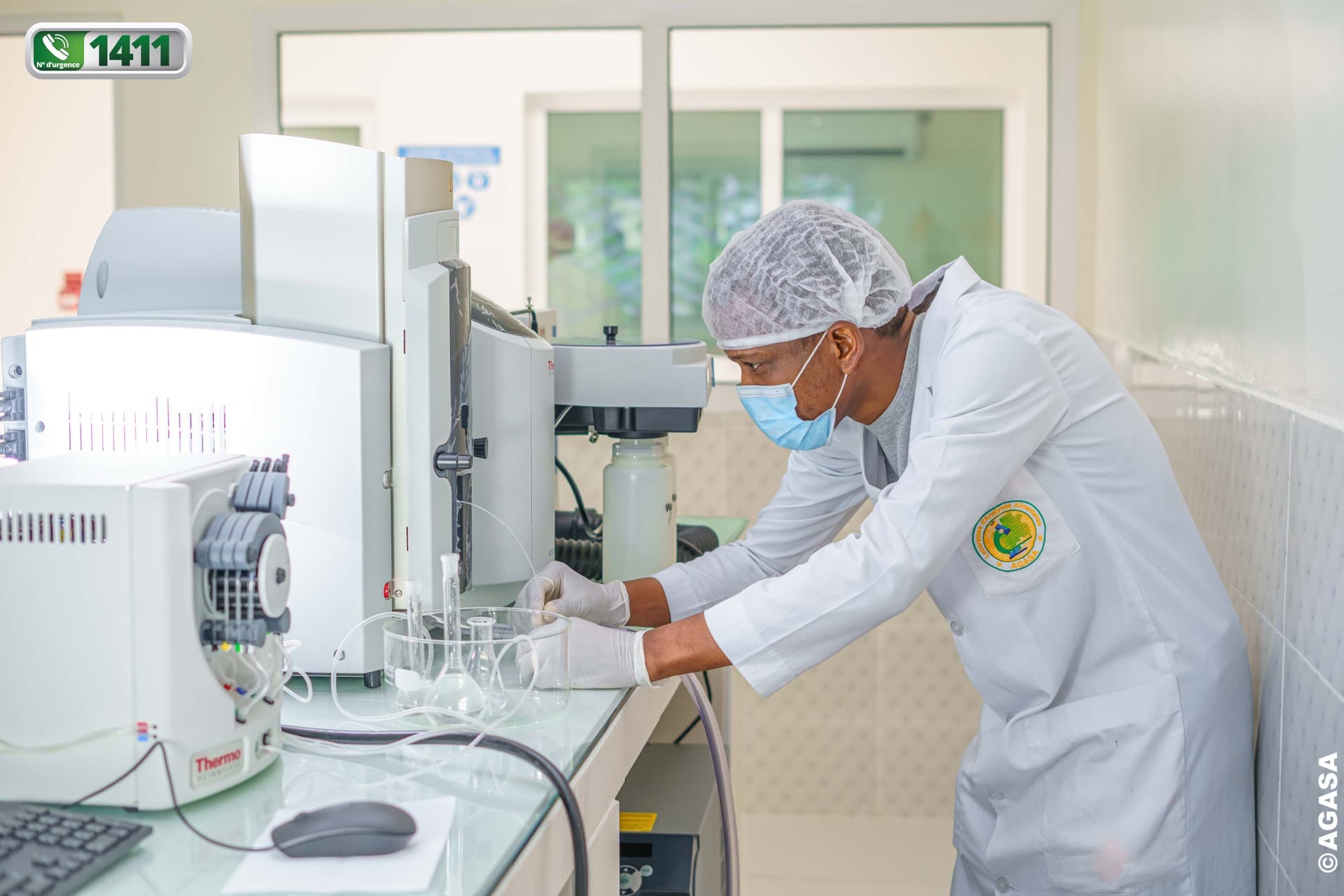
It is in this perspective that AGASA has equipped itself with a food analysis and quality control laboratory to carry out its mission of protecting the health of populations.
The establishment of a microbiological and physico-chemical analysis laboratory results from an imperative to respond to several problems existing within our society and whose purpose would be to secure the food sector.
This approach can contribute to reducing risks related to residues of phytosanitary products and veterinary medicines contained in food products.
It could eventually offer users reliable and quality analyses for the marketing of their products.
In short, preventing, evaluating, improving and guaranteeing the quality of food products on the national market, in order to preserve consumer health and promote international trade are the fundamental reasons for the need to establish this food analysis laboratory in Gabon.
This laboratory will allow the analysis of local food products before their marketing, imported food products.
The results of these analyses would help justify AGASA's actions related to the quality of a food product.
The activities of said laboratory would help guide, support and confirm the prevention and surveillance missions carried out by staff assigned to food inspection and health and phytosanitary risk assessment.